

cloud— server-side video recording stored in Daily’s cloudcloud-audio-only— server-side audio-only recordinglocal— client-side recording saved to the participant’s computerraw-tracks— individual media tracks stored in your own bucket
cloud
Records a Daily call server-side. By default, outputs video at 1920x1080, 30 fps, encoded as H.264 at 5 Mbps, and audio encoded as AAC at 96 kbps, in MP4 format. Files can be retrieved via the Daily REST API or from the Daily dashboard. Cloud recording supports custom video layouts. It’s the best choice when you need recording from any browser or device, or want control over the recording output’s look and feel. Cloud recording is available for HIPAA use cases when configured to store recordings in a customer-managed bucket — either Amazon S3 or OCI Object Storage.Turn on cloud recording
Setenable_recording to "cloud" at the room level to allow any participant to start a recording:
enable_recording on their meeting tokens instead:
startRecording(), updateRecording(), and stopRecording() to manage recording in your app.
To start recording automatically when a token holder joins, use the start_cloud_recording token property.
If a recording doesn’t start, wait for the recording-started event and retry startRecording() with exponential backoff if it doesn’t arrive. See retrying failed recording starts for example code.
Customize cloud recording layouts
Pass layout configuration tostartRecording() or updateRecording():
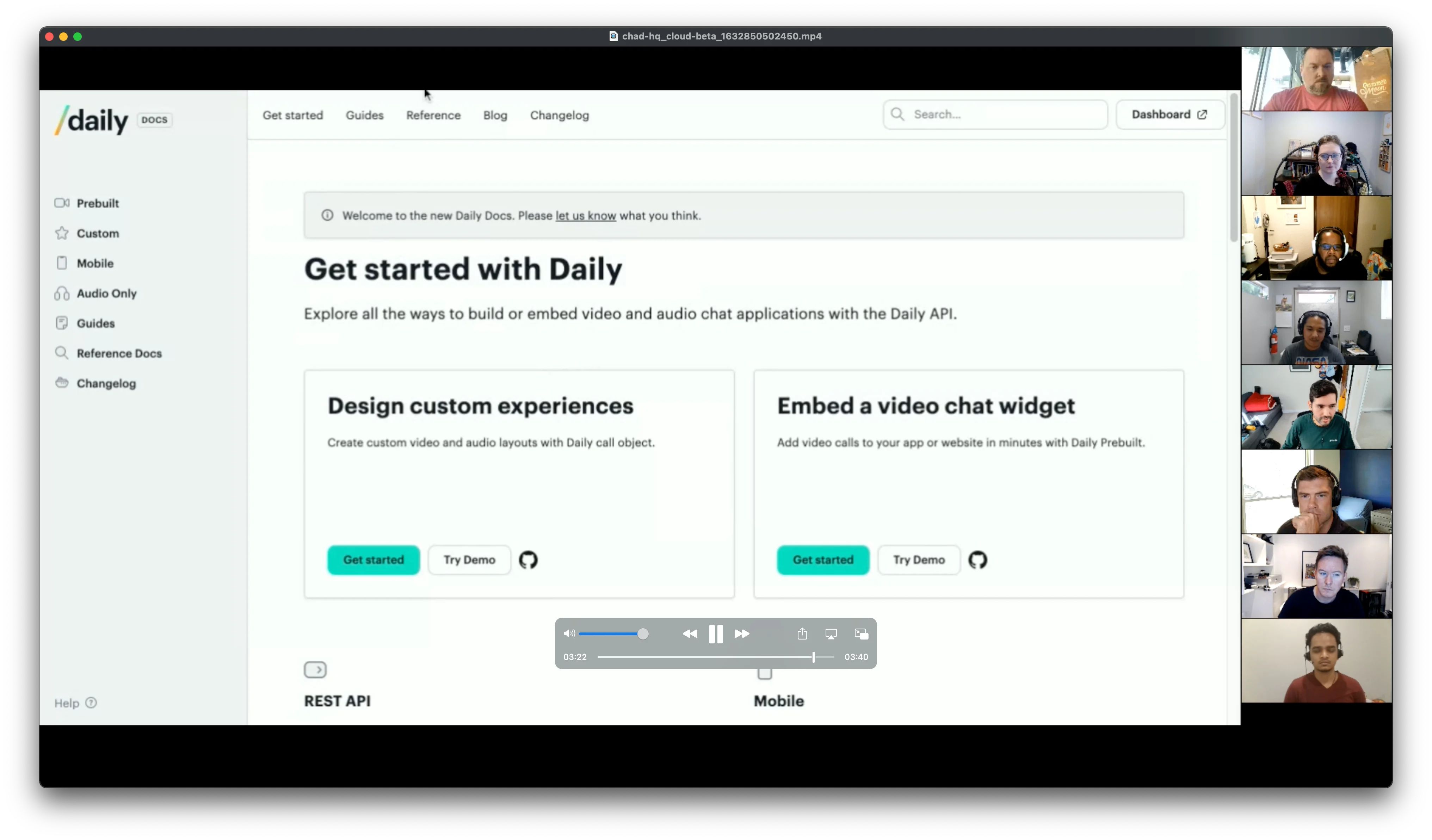
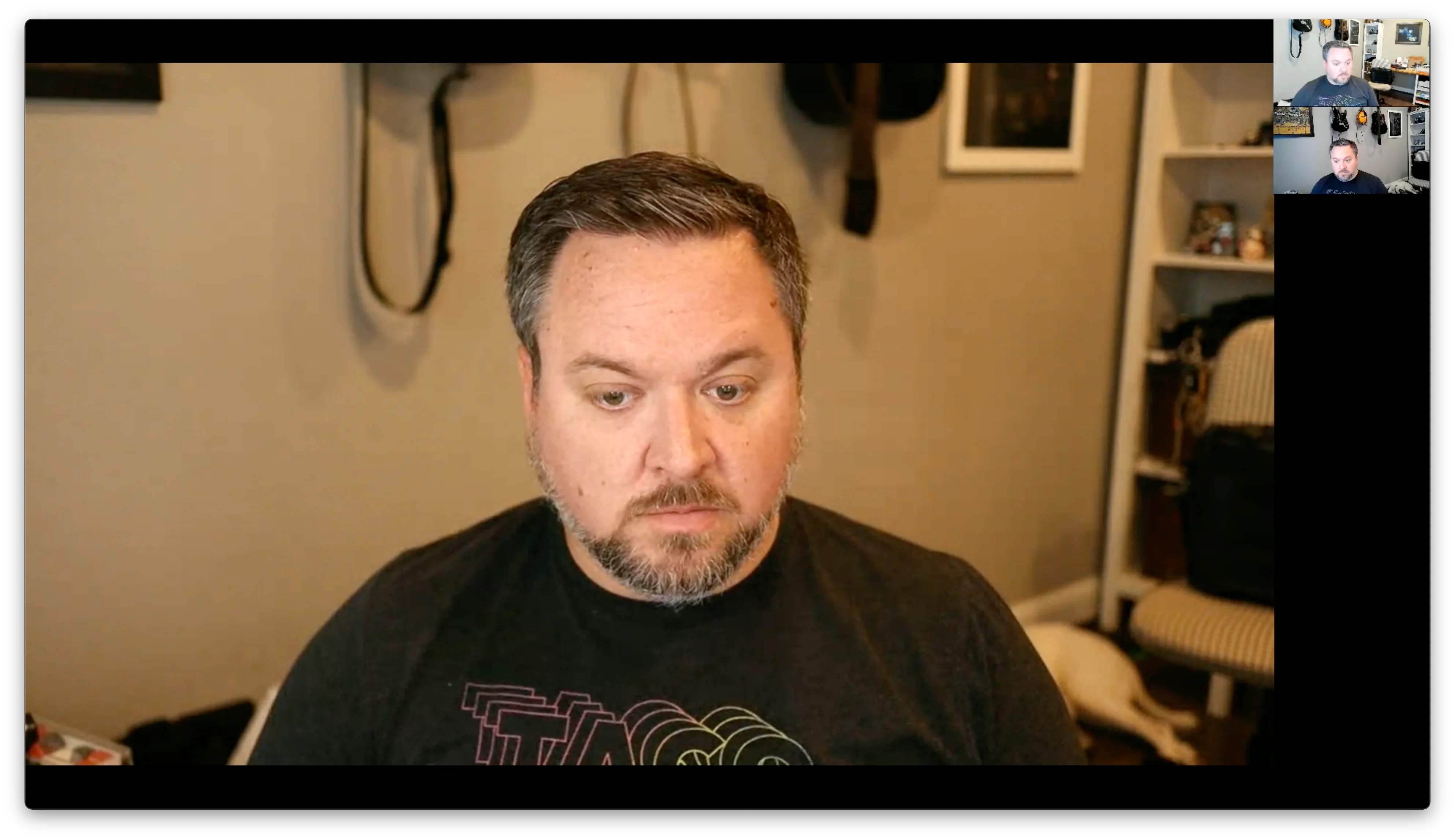
height,width— controls output resolution (set once viastartLiveStreaming()).backgroundColor— formatted as#rrggbbor#aarrggbb.This can only be set once via `startLiveStreaming().layout: an object specifying the way participants’ videos are laid out in the stream.preset: The layout preset to use. Options (see below for examples):"default"— grid layout; supportsmax_cam_streams(default 20, max 20)."single-participant"— stream only a single participant’s audio and video. The selected participant’s session ID must be specified via asession_idkey."active-participant"— This layout focuses on the current speaker, and places up to 9 other cameras to the right in a single column vertical grid in the order in which they last spoke."portrait"— mobile-friendly;"vertical"(default) or"inset"variant."vertical": up to two participants are shown in a vertical layout. Participants with theis_ownerflag are shown lower in the grid."inset": one participant’s video takes up the entire screen and the other is inset in a smaller rectangle. Participants’ videos are scaled and cropped to fit the entire available space. Participants with theis_ownerflag are shown full screen.
"custom"— full custom layout via VCS, withcomposition_paramsand optionalsession_assets. A full list of available parameters is available in the reference docs. You can also test available options with the VCS Simulator.
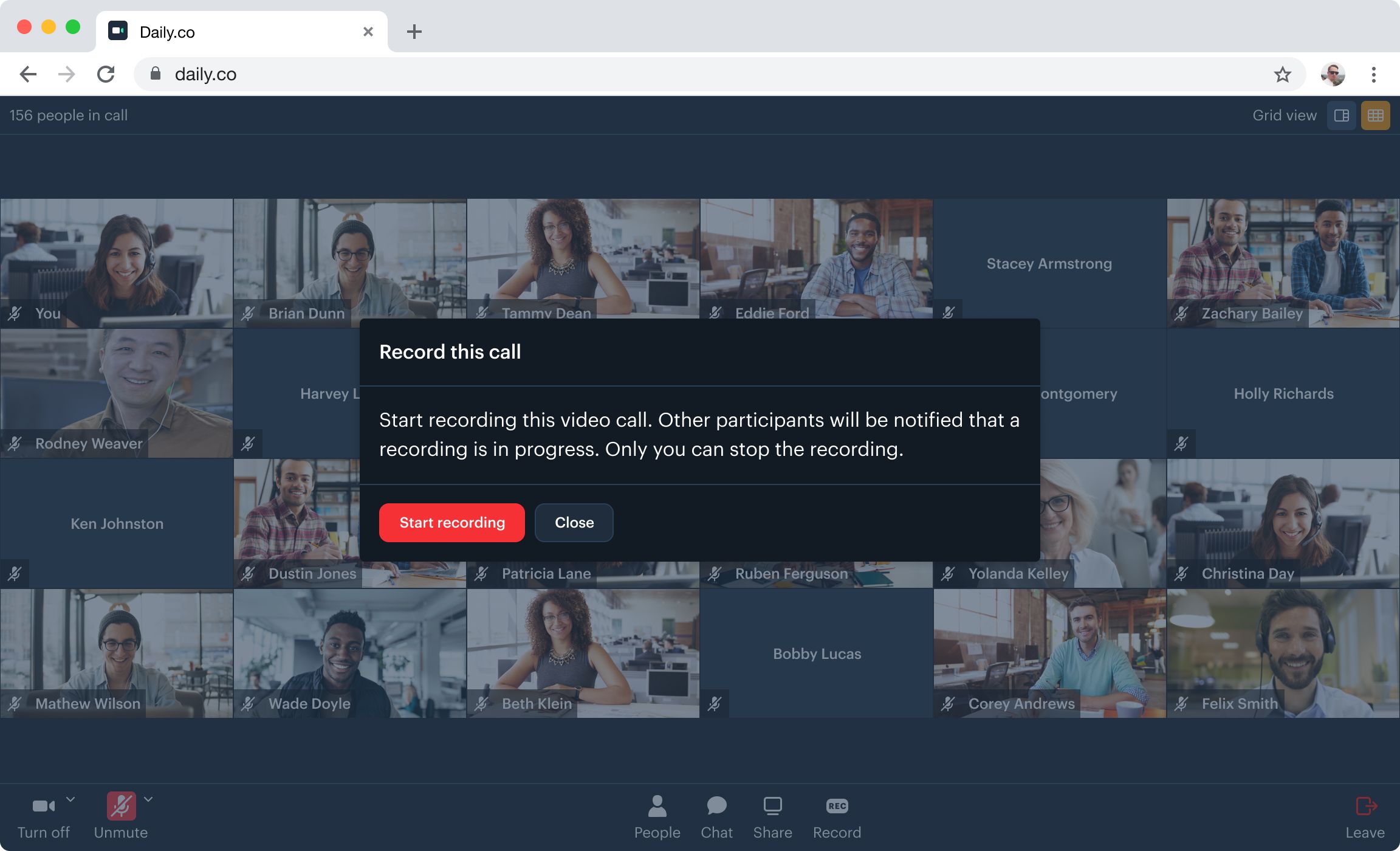
"default" layout:
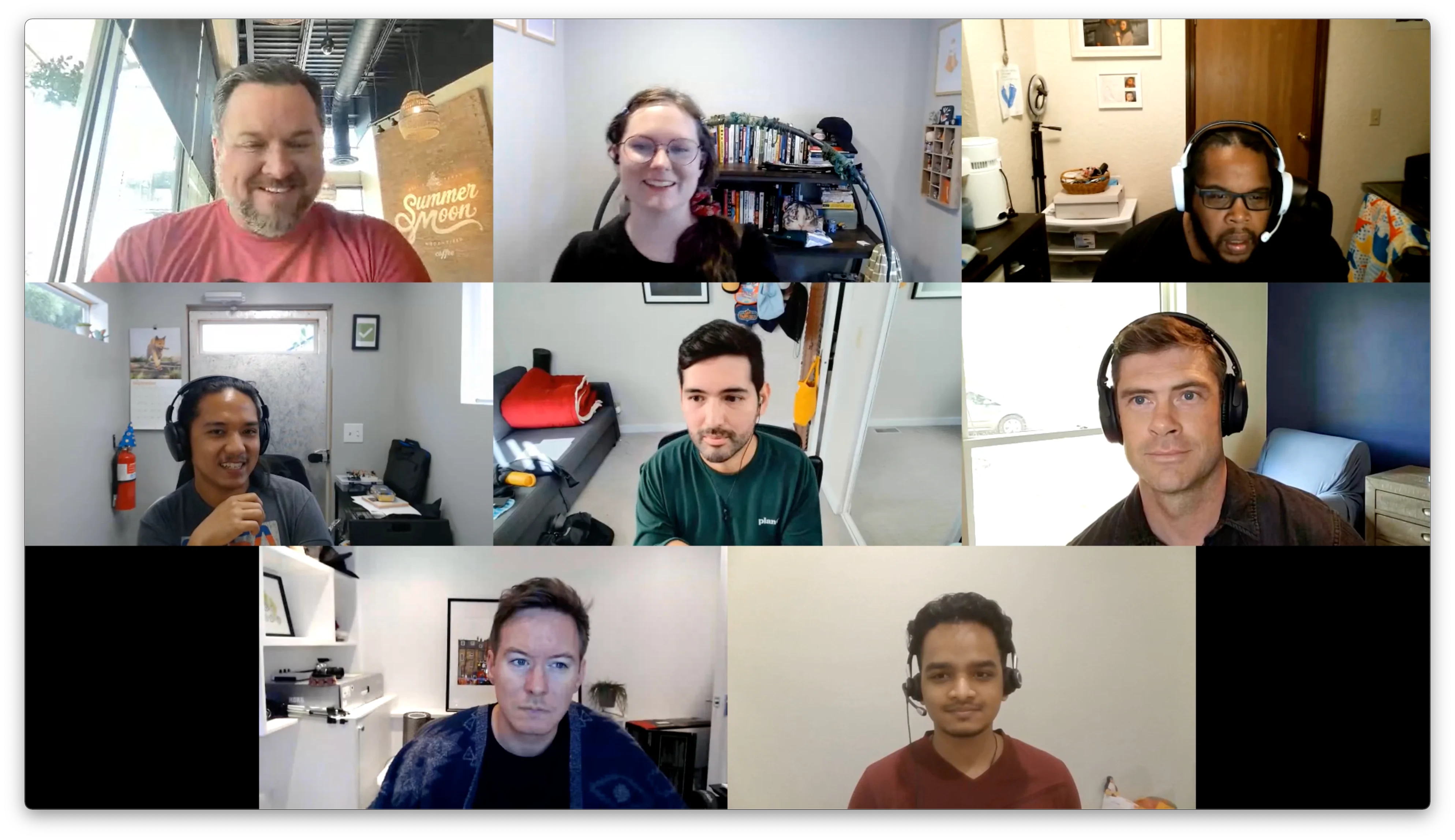
"default" layout:
"single-participant" layout:

"active-participant" layout:
"portrait" layout with "vertical" variant:

"portrait" layout with "inset" variant:
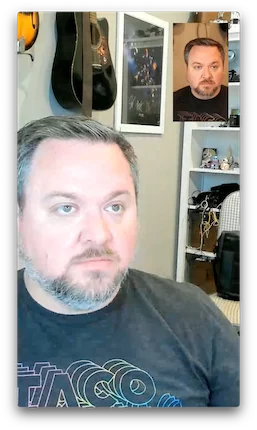
"custom" layout with a text overlay:
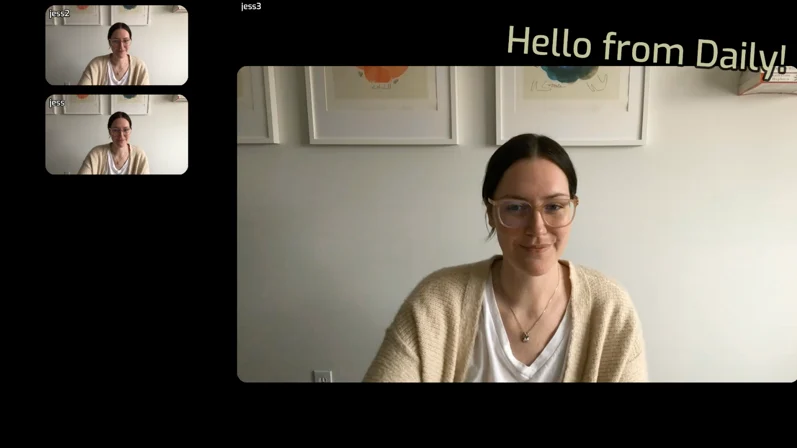
Retrieve cloud recordings
Cloud recordings are available in the Daily dashboard “Recordings” tab and via the recordings REST API.Using cloud recording with Daily Prebuilt
When cloud recording is enabled, end users can start recordings using the “Record” button. The layout is automatically selected based on their current view (grid →"default", speaker view → "active-speaker").
For programmatic control over recording and additional layout presets, use the startRecording() and updateRecording() methods with the layout parameter.
cloud-audio-only
Records a Daily call server-side and produces an audio-only MPEG-4 file (.m4a). Configuration and retrieval work the same as cloud, except layout options don’t apply.
Enable it by setting enable_recording to "cloud-audio-only" at the room or meeting token level (same pattern as cloud above). The start_cloud_recording token property applies to both cloud and cloud-audio-only.
Available for HIPAA use cases when using a customer-managed bucket — either Amazon S3 or OCI Object Storage.
local
Local recording saves the finished recording as a.webm file on the recording participant’s computer. The file may need to be transcoded for compatibility with most devices and editors.
Use this type to access recordings directly on a participant’s computer rather than through Daily’s cloud. Local recording is also HIPAA-compatible.
Turn on local recording
startRecording() and stopRecording() to manage it.
The recording is downloaded to the computer of the participant who stops it.
Using local recording with Daily Prebuilt
Tell the participant who started recording to click “Stop” before leaving the call. If they leave without stopping, the recording will be lost. Daily Prebuilt attempts to warn the user before they leave.raw-tracks
"raw-tracks" captures each individual media track separately and stores them in your customer-managed bucket — either Amazon S3 or OCI Object Storage.
Use this type when you need to manage individual media tracks separately — for high-quality audio transcription, podcasts, or video production.
Turn on raw-tracks recording
startRecording() and stopRecording() to manage it.
Gapless transcoded audio
By default, each raw-tracks audio file is the participant’s Opus stream stored as-is in a.webm container. Because it captures samples as they arrived over WebRTC, the file can contain gaps: a muted mic, an idle period, or packet loss leaves a hole in the timeline. Those gaps make it harder to line tracks up after the call.
Set enable_raw_tracks_transcoded_audio to have Daily decode each audio track, fill any gaps with silence, and re-encode it as a continuous (gapless) file. This keeps each track’s audio flowing without holes, which makes alignment and post-processing simpler.
You can set it on a room or on your domain. A room value takes priority over the domain value.
Two shorthand aliases are accepted:
wav and wav-48k both map to wav-48k-stereo, and wav-44k1 maps to wav-44k1-stereo.
Notes:
- This setting only affects audio tracks. Video tracks are unchanged and still record as
.webm. - Leave it unset (or use an empty string) to keep the default Opus-in-
.webmaudio behavior. - The transcoded audio replaces the default
.webmfile for that track. It is not written alongside it. Each audio track produces exactly one file in your bucket: either the default Opus-in-.webmfile, or the transcoded WAV or MP4 file. So this setting is a choice between two outputs, not a way to get both. If you need the original Opus audio, leave this setting unset. - WAV gives you lossless audio at the cost of larger files. AAC is smaller and fixed at 160 kbps.
- It fills gaps inside each track so the audio is continuous. It does not pad the start of a late joiner’s track to match when the meeting began, so different participants’ files can still start at different points. Use the raw-tracks-tools CLI to align tracks to a shared timeline.
Converting and compositing .webm files
Raw-tracks (and local) recordings produce.webm files, which may not play in most video players or be directly editable. This is because they capture raw samples as-is from the WebRTC session — with variable frame rates, varying resolutions, and potential gaps from packet loss.
Using raw-tracks-tools CLI
Daily’s open-source raw-tracks-tools CLI can:- Analyze and convert individual participant tracks
- Align audio and video tracks for sync
- Composite all tracks from a recording into a single MP4 using VCS
Transcoding .webm files with a GUI
Two common options:- CloudConvert — browser-based, free and paid plans. Convert
webmtomp4(orwebmtomp3for audio-only). - Handbrake — free app for Windows and macOS. Drag and drop your
.webmfile, set Format toMP4and Video Encoder toH.264 (x264), click Start.
.webm files without transcoding in Chrome, Firefox, or VLC Media Player.
Multiple Recordings
See Multi-instance live streaming and recording for full details, including how to configuremax_streaming_instances_per_room for your domain.